No future
28 February 2026
LOVE has lost, 2026
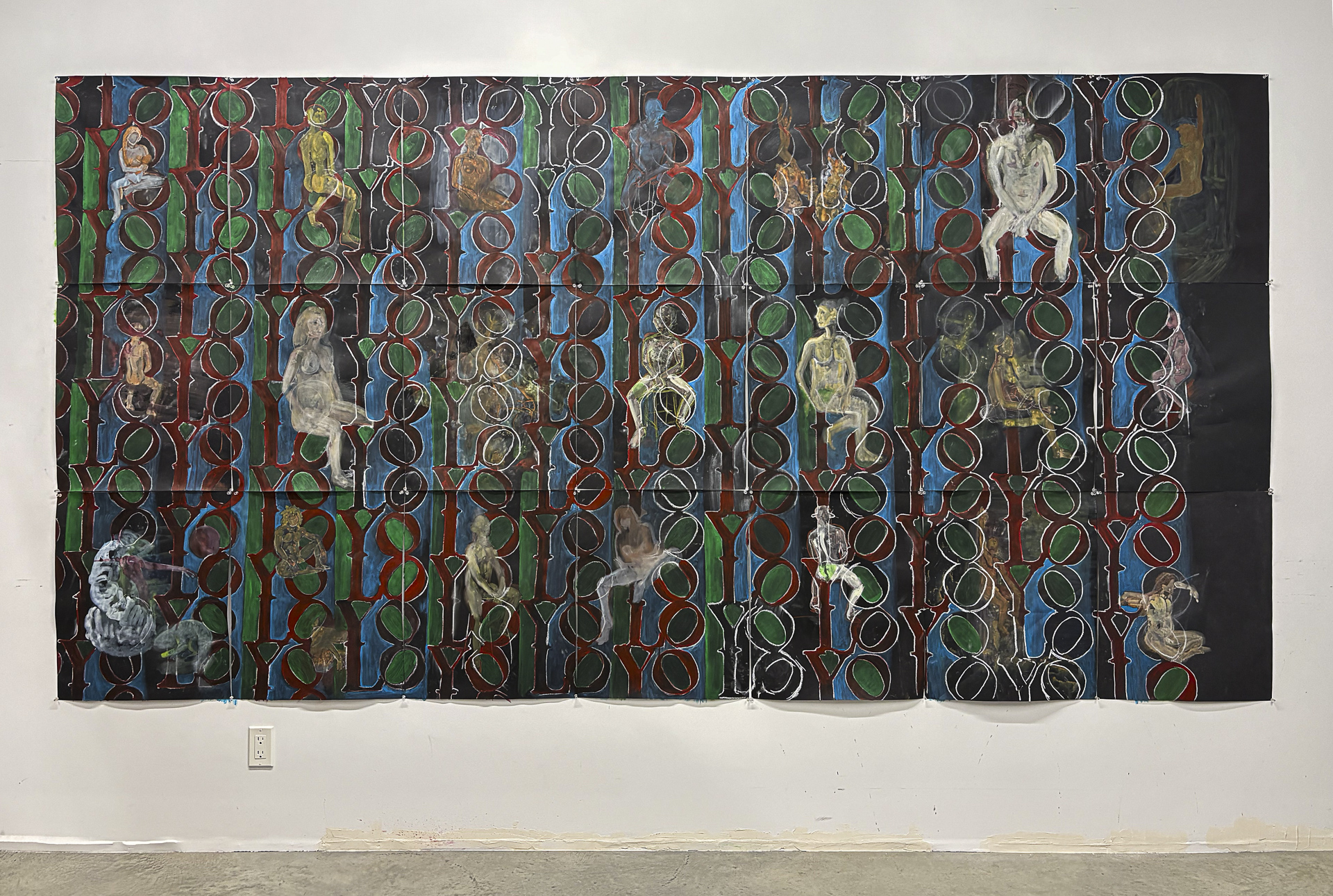
Carpe diem : étude 1 (en cours), des individus nus dans l'ère ambiant, 2026, Craie, aquarelle et acrylique sur canson noir. 180 x 350 cm
The work LOVE (1964) by Robert Indiana is a symbolic marker that quite simply encapsulates the tone of an era in which social movements gave rise to the “peace and love” generation, also known as the baby boomers. Social revolutions followed one another in rapid succession; sexual freedom, gay and lesbian rights, women’s rights, and the rights of racialized people are just a few examples.
In the 1980s, General Idea borrowed Indiana’s form in order to inscribe the acronym AIDS. The members of the collective succeeded in expressing, through a four-letter term, an idea that suggested an image linking love and death in a strikingly accurate way, resonating with my own existential anxiety at the time—a period when fear coexisted with desire, and when the Cold War still inhabited part of our collective psyche for Generation X.
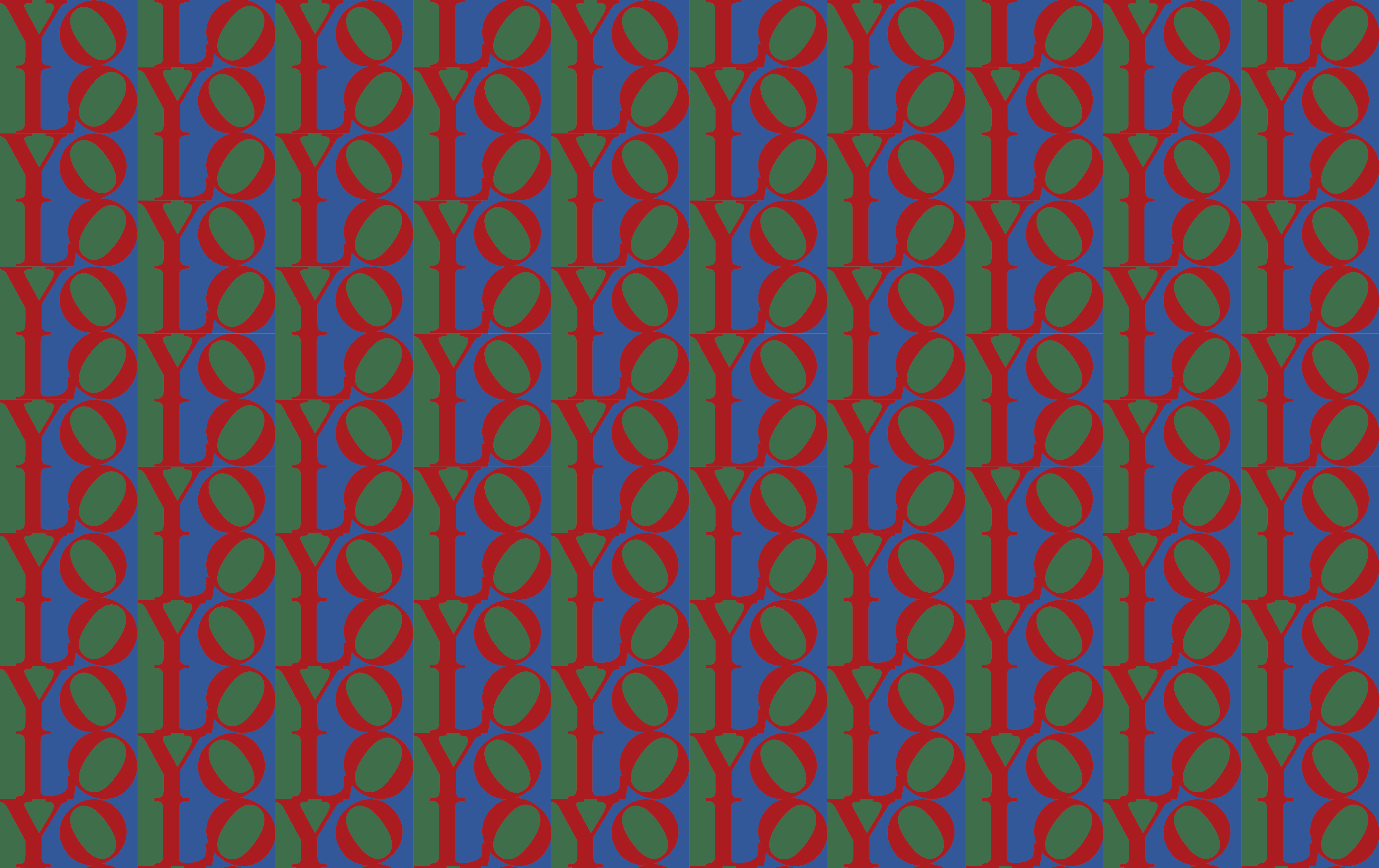
In the 2000s, the acronym YOLO (You Only Live Once) emerged on the Internet, conveying the idea that one must seize every opportunity that arises, encouraging risk-taking. This expression, which became omnipresent on social media in the early 2000s, seems to me symptomatic of a particularly individualistic era associated with millennials.
Since 2020, in the era of COVID, the use of the acronym FOMO (Fear Of Missing Out) has continued the inward turn of the 2000s while introducing the idea of the fear of missing something—fear of running out of time—as a pre-apocalyptic vision of enjoyment that is often associated with Generation Z.
I am currently working on a study introducing the YOLO and FOMO logos in the manner of Robert Indiana. My first attempt is based on an assembly of 21 life-drawing sketches produced by CEGEP students. These drawings were retrieved from discarded materials, reworked in watercolor, then assembled into a large surface and interwoven with a pattern of YOLO logos painted in red, green, and blue acrylic.
Life drawing develops the ability to observe and understand the unfolding of organic forms in space, but above all it opens us to the nudity of the other’s body; it teaches us to objectify the gaze, to rationalize our conditioning toward judgment, to move beyond taboos, to break social codes, to recognize fragility, to appreciate life in all its forms, and to apprehend the sense of freedom that emerges from it.
This sense of freedom appears to me as inherent to the idea of YOLO—the notion of a last chance, the desire to fully experience and inhabit one’s body to the very end.